When to prune apple trees. And pears, while we're at it.
Free-standing apple and pear trees are pruned in winter, while they're dormant. Trained forms get a summer trim as well. Here's the timing, why it matters, and how hard to cut a neglected old apple back.
Josh Mullett, JM Tree Surgery & Fencing Services · Josh Mullett, on why the diary runs fruit pruningAn apple tree you prune in January will thank you in October. The same cuts in May just bleed and sulk.
The short answer
A free-standing apple tree is pruned in winter, while it’s dormant and bare. Any time from leaf-fall in November through to the buds breaking in late February is fine, with December and January the sweet spot. Pears go on exactly the same diary. They’re both pome fruit and they want the same winter treatment.
That’s the rule that covers most gardens. If you’ve got a normal apple or pear standing in the lawn, wait for a still day between Christmas and the end of January and get on with it.
Why winter, and not summer
With the leaves off you can actually see the tree. The branch structure is laid bare, the crossing limbs and the dead wood show up plainly, and you make your cuts to the right place instead of guessing through foliage.
There’s a growth reason as well. Winter pruning is invigorating. The tree is sitting on a full set of roots and a winter cut tells it to push hard in spring. That’s what you want on a free-standing apple: strong new framework wood, a good open shape, plenty of fruiting spurs coming through. The cuts also seal cleanly because disease pressure is low in cold air.
The aim through the middle of the tree is an open goblet. Light and air reaching every branch, no congested centre, nothing rubbing. An open apple crops better and gets less scab and mildew than a tangled one.
The exception: trained apples and pears
If your apple or pear is a trained form (a cordon, an espalier against a wall, a fan or a stepover), the rule flips. Those get their main prune in summer, usually mid-July into August.
Summer pruning does the opposite of winter pruning. It restricts growth and keeps the tight, flat shape you’re after, while letting sun onto the fruit to ripen it. A trained tree winter-pruned hard would throw out a forest of vigorous water shoots and lose its shape in a season. So: free-standing, winter; trained and restricted, summer. A trained tree often gets a light tidy in winter too, but summer is the main event.
The trap people fall into
Here’s the one that catches people out. The winter rule is for apples and pears only. It does not carry across to the stone fruit.
Plums, cherries, gages, damsons, apricots, anything in the Prunus family, are pruned in summer, never in winter. Cut a plum or a cherry in the dormant season and you open the door to silver leaf disease, which travels through fresh wounds in autumn and winter. We’ve taken out plenty of plums that were killed by nothing more than a well-meant winter prune. If you’ve got a mixed little orchard, prune the apples and pears now and leave the plums and cherries until June.
There’s a fuller breakdown in the when to prune fruit trees guide, and you can see any species’ full year on the tree and hedge care calendar.
How hard to cut
On a tree that’s pruned every year, you’re just tidying: take out the dead, the diseased and the crossing wood, shorten the leaders a little, thin the spurs if they’re congested. Light work.
A neglected old apple is a different job. The temptation is to cut it all back in one go. Don’t. Take no more than about a quarter of the crown in any one winter, or the tree panics and throws up a thicket of vertical water shoots that fruit nothing and shade everything. A proper renovation of an overgrown orchard apple runs over two or three winters, opening it up a stage at a time.
Use the three-cut method on anything heavier than wrist-thick so the bark doesn’t tear, and cut back to a healthy bud or a side branch, not to a stub. Clean tools between trees if anything looks diseased.
What’s happening the rest of the year
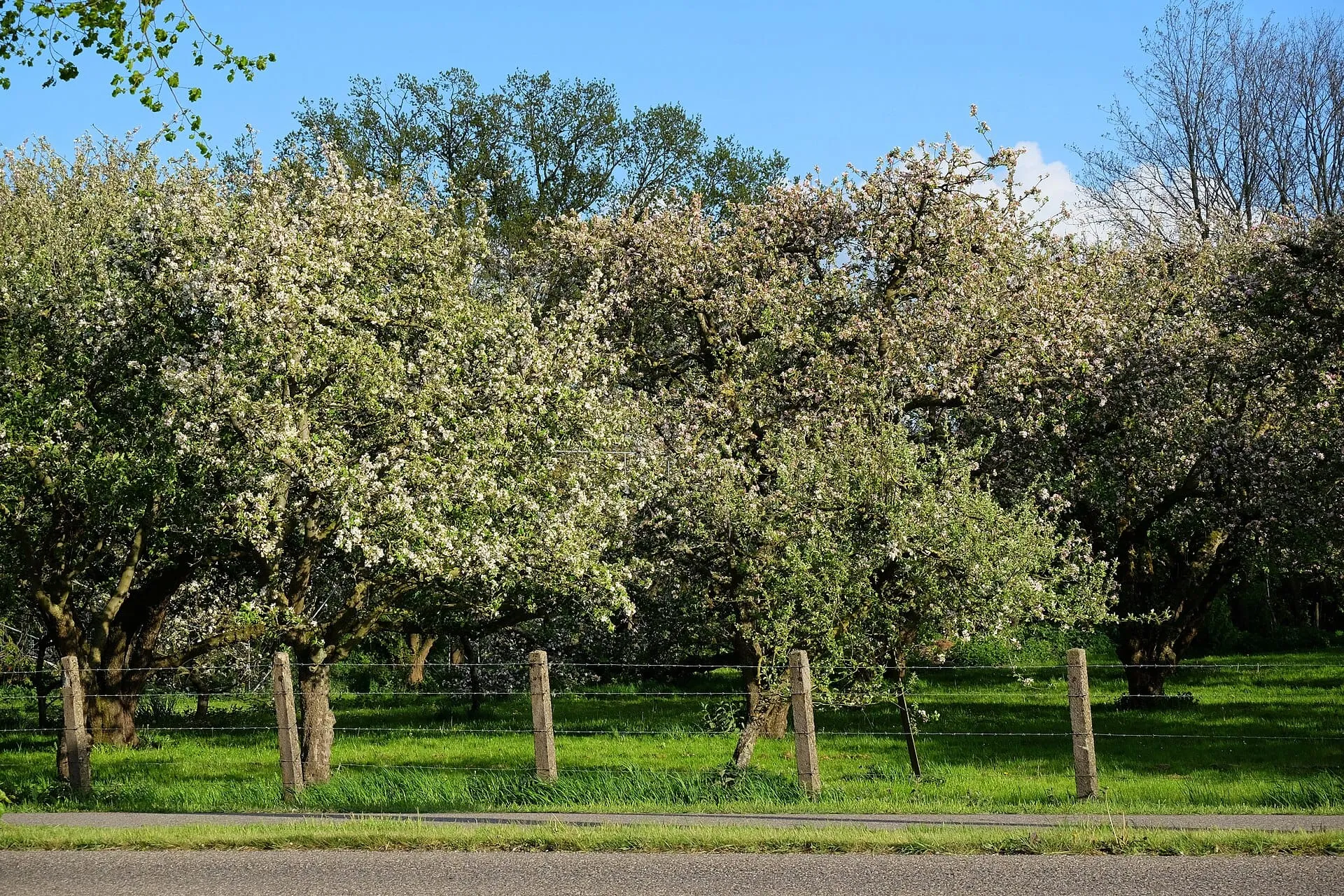
It helps to know the tree’s own calendar. Apple blossom comes through April and into May, which is when the bees do their work and the fruit sets. The harvest is September and October for most varieties, earlier for the eating apples, later for the keepers and the cookers. None of that is pruning time. Resist the urge to “tidy” a fruiting apple in late summer beyond the trained-form summer prune.
A note on East Sussex gardens
Half the apples we get called to are old Wealden orchard trees that haven’t seen a saw in twenty years. Big, top-heavy, hollowing at the base, cropping high up where nobody can reach. Those are worth saving nine times out of ten. The right move is a staged winter reduction and renovation, not a fell. A mild coastal winter round Hastings and Bexhill can run a week or two ahead of the inland Weald, so watch your own tree’s buds rather than the calendar date.
If a fruit tree has gone too far, or it’s grown into a shed or a boundary, that’s a crown reduction job rather than a bit of secateur work, and we’re happy to take a look.
The short version, if you’re skim-reading
- Free-standing apples and pears: prune in winter (November to February, ideally December to January), while dormant and bare.
- Trained forms (cordon, espalier, fan): main prune in summer, July to August, to restrict growth and ripen fruit.
- Never winter-prune plums or cherries. Stone fruit is summer-only, to dodge silver leaf disease.
- Aim for an open goblet: light and air through the middle, no crossing or congested wood.
- Neglected trees: no more than a quarter of the crown per winter, renovate over two or three years.
- Blossom is April to May, harvest September to October. Neither is pruning time.
If you’ve got an old apple or a tangled orchard somewhere between Hastings, Battle, Bexhill, Rye and Heathfield and you’d rather someone took it on, send us a note with a photo and we’ll tell you straight whether it’s a renovation or a removal. To see any tree or hedge’s whole year at a glance, use the tree and hedge care calendar.