Pollarding
Pollarding is a traditional management technique that keeps a tree at a set size over decades, by cutting back to the same points on a regular cycle. It works on the species that tolerate it, done at the right time of year, by someone who knows the difference between a pollard and a topped tree.
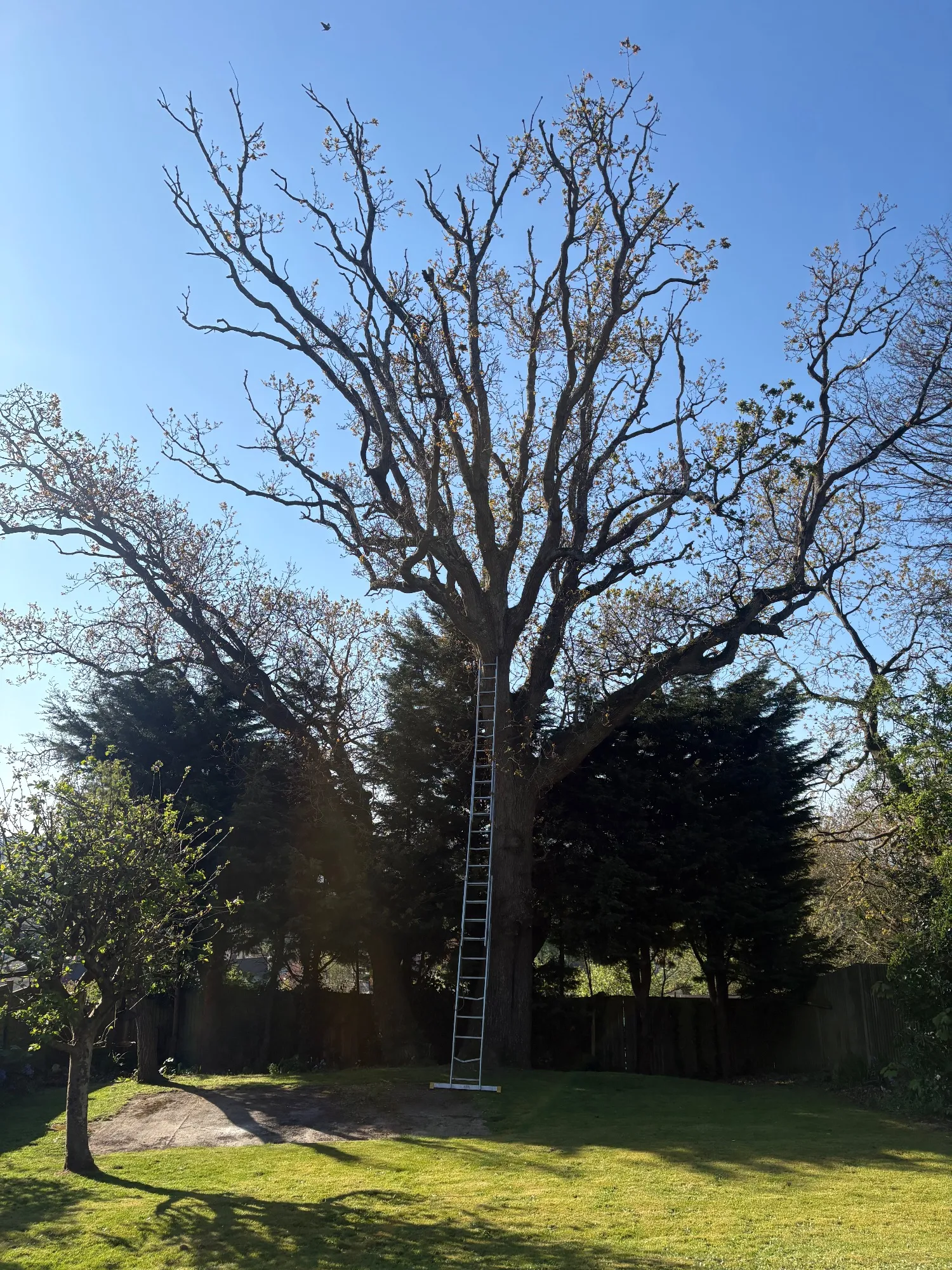 Before
 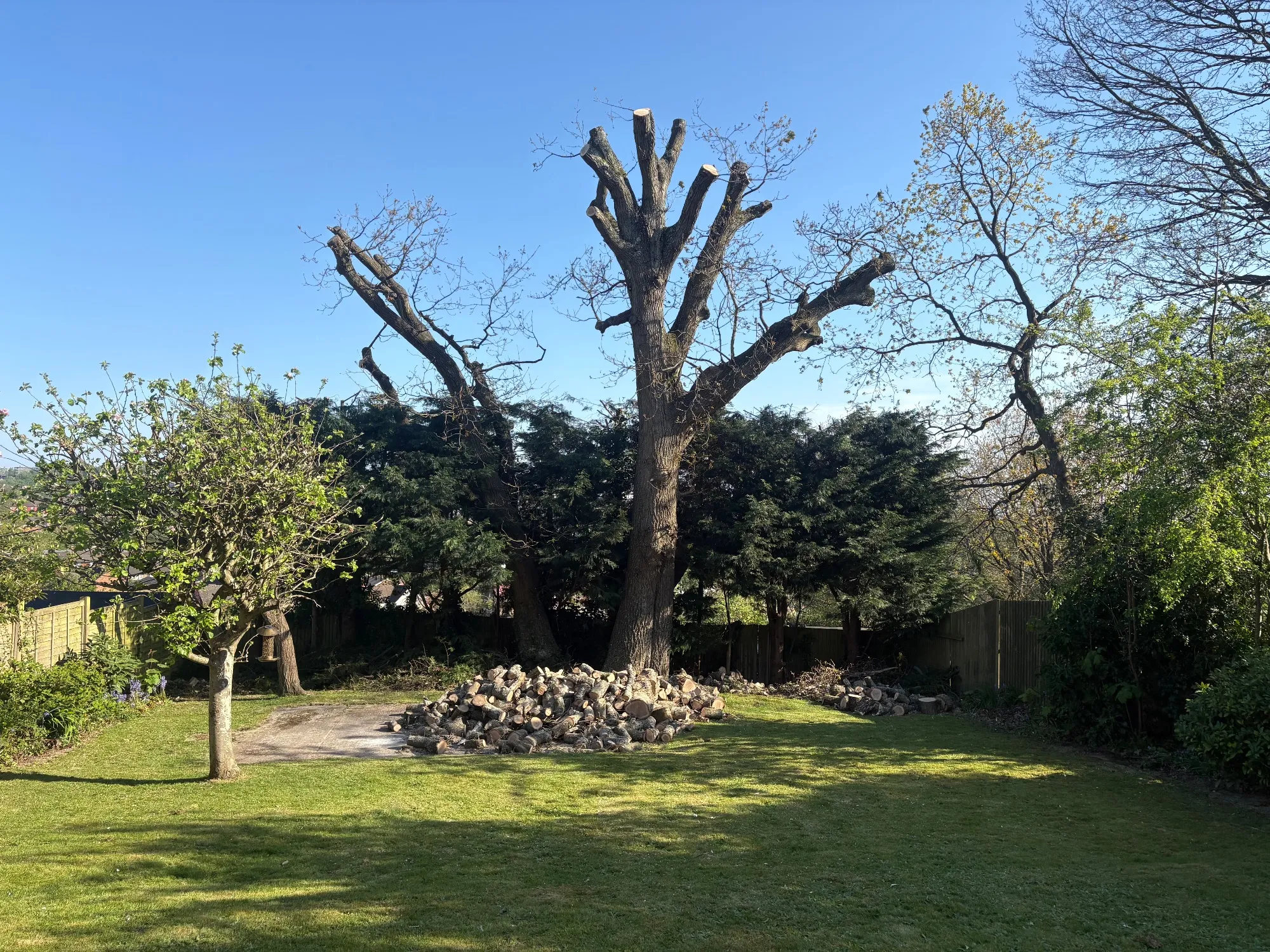 After
After What it is, and what it isn't
Pollarding is the repeated cutting back of a tree to the same points, year after year or on a set cycle, so the tree puts on new growth from known nodes. Done properly, you get a recognisable pollard head at each cut point, and the tree can be managed at the same size for a hundred years or more. It's a traditional technique, widely used on willow, lime, London plane, poplar and hornbeam.
Each cut point builds up over time into a knuckle, a swollen knobbly head with a dense bank of dormant buds underneath it. The knuckle is the whole trick. Cut just above it and the tree pushes new shoots within weeks. Cut into it and you've taken the bud bank out.
It is not topping. Topping is a one-off hack at a convenient height, leaving stubs with no relationship to where the tree wants to grow. Pollarding is a long-term management regime, started when the tree is young or on an appropriate species, and maintained on a cycle to BS3998. If a tree has never been pollarded and is now fifty years old and thirty feet up, starting a pollard regime isn't usually the right answer. A reduction is.
Which trees pollard, and which don't
This is the question worth getting right before anyone quotes you, because the species decides whether the job is pollarding or a mutilation with a nicer name.
Take it well. Willow, lime, London plane, poplar and hornbeam are the classic pollard species. They put new growth out of dormant buds at the cut points reliably, season after season. Hawthorn pollards on old farm boundaries. Mulberry takes it. So does sycamore, which is why you see pollarded sycamores on exposed field edges round here.
Eucalyptus is the one we get asked about most in gardens, usually a gunnii planted twenty years ago that's now taller than the house. It pollards and coppices happily. It regrows fast, which is the point and also the commitment: expect to be back on it every two or three years.
Ash was pollarded across English wood pasture for centuries and the species itself tolerates it. In East Sussex the honest answer now has a caveat. Most of the ash we're called to has dieback, and a tree already losing crown is a poor candidate for a hard cut. On a healthy ash a pollard is a real option. On a declining one the conversation is usually about safety and felling instead, and we'll say so. There's more in our ash dieback guide.
Don't take it. Oak and beech do not pollard from a standing start. Neither do birch or cherry. Most conifers won't reshoot from old wood at all, so a hard cut on a leylandii or a spruce leaves you with brown stubs that stay brown. If someone has quoted you for "pollarding" an oak or a beech, what's being described is topping.
Apple and other fruit trees aren't a pollarding job either, though people search for it. An overgrown apple wants renovation pruning, taken in stages across two or three winters, keeping the fruiting wood. Cut an apple back to bare knuckles and you get a thicket of water shoots and no fruit. We've written the proper version up in our apple tree pruning guide.
Pollarding and coppicing
Same idea, different height. Coppicing cuts the tree back to a stool at ground level. Pollarding does the same job about two metres up, historically so deer and grazing stock couldn't reach the new growth. Both keep a tree productive and alive for centuries, and both rely on the species reshooting from the cut.
Where the choice matters to a garden: coppicing gives you a multi-stemmed shrub from the base, pollarding keeps a clear trunk with the growth held above head height. On a boundary willow you might do either. Next to a path or a drive, the pollard is usually the one you want.
When a pollard is the right call
- You've got a willow, lime or plane already being managed on a pollard cycle, and it's due its regular cut.
- A young tree has been planted where a full-size specimen won't fit, and you want to start a pollard regime from the outset.
- A street or garden lime has been pollarded historically and you want to carry on the cycle rather than let it run to a full tree.
- A working willow boundary needs its regular two- or three-year cut-back.
- A eucalyptus has got away from you and needs bringing down to a size you can keep on top of.
- A mature tree is heavily in decline. On a pollard-tolerant species this reduces the sail and the storm-damage risk, and gives the tree a chance to rejuvenate back into life.
How we do it
- Check the tree is suitable and already on a cycleWe won't start a pollard regime on a mature tree that hasn't been managed that way, because the cuts don't behave the same.
- Find every knuckle before the saw comes outEach previous cut point is a knuckle. We cut just above it, not into it, and leave a clean face for the tree to seal.
- Right time of year for the speciesWillow and poplar tolerate winter cuts. Lime, plane and hornbeam prefer late winter into early spring. Eucalyptus goes in spring once the frosts are done. We time the cycle to the tree.
- Nesting-bird check between March and AugustLegal duty. If there's an active nest, we wait or we work around it.
- Set the next cut before we leaveA pollard is a cycle, not a visit. You'll know roughly when we should be back before we're off the drive.
When to pollard, by species
Timing is half the job. A cut in the wrong month on the wrong species is how a healthy tree ends up struggling.
- Willow and poplar. Any time in the dormant season, roughly November to February. These are the forgiving ones.
- Lime, plane and hornbeam. Late winter into early spring, before the buds break. Lime in particular sulks if you cut it in high summer.
- Eucalyptus. Spring, once the hard frosts have passed. A fresh cut going into a cold snap is where eucalyptus dieback starts.
- Sycamore and healthy ash. Late winter, same window as lime.
- Anything, March to August. Nesting season. We check first, every time, and if there's an active nest the job waits.
Can pollarding kill a tree?
On the right species, cut above the knuckle at the right time of year, no. That's the whole reason the technique has survived several hundred years. Pollarded limes and willows routinely outlive unpollarded trees of the same species, because they never get big enough to tear themselves apart.
It kills trees in three situations, and all three are avoidable. Wrong species, where there are no dormant buds waiting to push, which is what happens to a topped oak. Cutting into the knuckle rather than above it, which takes out the bud bank. And the first hard cut on a mature tree that has never been pollarded, where the branches have long since committed to their structure and there's nothing left to grow back from.
That last one is the one we turn down most often. If your tree is mature and has never been pollarded, the honest answer is usually a crown reduction to BS3998 instead.
What we won't do
We don't top trees. If someone's told you to "top" an oak, a birch or a cherry, they're not describing a pollard, they're describing the job we won't do. Topping is a near-guaranteed way to shorten a tree's life and double the cost over ten years. On suitable species already on a cycle, we pollard. On everything else, we'll reduce, thin or fell as the tree actually needs. The full technical case is in our crown reduction vs pollarding guide.
TPOs and conservation areas
If your tree is in a conservation area and over 75mm in diameter at 1.5 metres, you generally need to file a Section 211 notice before any cut, even a regular pollard. A TPO'd tree on a pollard cycle usually has the cycle described in the original consent, and we work to that. We file the paperwork with your local council on your behalf and wait the clock out before we put a saw in. Not sure which applies to you? Our tree protection checker will tell you in about a minute.
What pollarding costs
Priced per tree after a free site visit. Size, access, whether the tree is already on a cycle and how long since the last cut all move the number. A willow on a three-year cycle is a quicker job than a lime that's been left for eight and needs bringing back to its heads. Height matters more than most people expect, because a pollard above about eight metres means climbing or a MEWP rather than working off the ground.
The thing worth budgeting for is the cycle, not the visit. A pollard you keep on top of every two or three years is a short job each time. A pollard you leave for a decade becomes a much bigger one, with heavy limbs coming off knuckles that were never sized to carry them. We put a written quote in front of you within two working days of looking at it.
See how we price every job, across tree surgery and fencing →
Reviews from tree surgery work
★★★★★“We needed to take down a large dead Elm tree and found Josh's details locally. Josh did a fantastic job, no fuss and left the site immaculate. I would absolutely recommend Josh for tree works.”
★★★★★“Josh has helped us over many years with a variety of jobs in our large garden. Mostly he has cut our hedges every autumn. It's a big job over a few days and the result is fantastic. The hedges look great and the topiary too. He is meticulous in everything he does. A couple of times we have needed urgent work done on falling trees and he has responded immediately on the day. I would highly recommend his services.”
Related work
Have a look at recent tree surgery jobs we've done nearby.
Pollarding across East Sussex
We cover about twenty miles around Heathfield, which takes in Hastings, Battle, Bexhill, Rye and the villages between. Each town page has what the ground and the trees are actually like there.
Pollarding questions
Can pollarding kill a tree?
On the right species, cut just above the knuckle at the right time of year, no. Pollarded limes and willows routinely outlive unpollarded trees of the same species, because they never get big enough to tear themselves apart. It goes wrong in three situations: the wrong species, where there are no dormant buds waiting to push; cutting into the knuckle instead of above it, which takes out the bud bank; and a first hard cut on a mature tree that has never been pollarded, where there is nothing left to grow back from. That last one is the job we turn down most often.
Which trees can be pollarded?
Willow, lime, London plane, poplar and hornbeam are the classic ones. Hawthorn, mulberry, sycamore and eucalyptus all take it too, and so does healthy ash. Oak, beech, birch, cherry and most conifers do not pollard from a standing start. If you have been quoted for pollarding on an oak or a beech, what is being described is topping under a nicer name.
What is the difference between pollarding and coppicing?
Same idea, different height. Coppicing cuts the tree back to a stool at ground level. Pollarding does the same job about two metres up, historically so deer and grazing stock could not reach the new growth. Coppicing gives you a multi-stemmed shrub from the base. Pollarding keeps a clear trunk with the growth held above head height.
When is the best time to pollard a tree?
Willow and poplar take a cut any time in the dormant season, roughly November to February. Lime, plane and hornbeam prefer late winter into early spring, before the buds break. Eucalyptus wants spring, once the hard frosts have passed, because a fresh cut going into a cold snap is where eucalyptus dieback starts. Between March and August we check for nesting birds first, every time, whatever the species.
How often does a pollard need cutting?
Willow, poplar and eucalyptus want a cut every two to three years. Lime and plane more like three to five. Hornbeam can run longer. Skip too many cycles and the regrowth gets heavy, the knuckles carry more load than they were sized for, and branches start failing at the join. If you start a pollard cycle, budget for the return visit.
What does pollarding cost?
We price it per tree after a free site visit. Size, access, whether the tree is already on a cycle and how long since the last cut all move the number. Height matters more than most people expect, because a pollard above about eight metres means climbing or a MEWP rather than working off the ground. A written quote follows within two working days.
Do I need permission to pollard a tree?
If the tree is in a conservation area and over 75mm in diameter at 1.5 metres, you generally need to file a Section 211 notice before any cut, even a regular pollard. A tree under a TPO usually has its pollard cycle described in the original consent, and we work to that. We file the paperwork with your local council on your behalf and wait the clock out before we start.
Got a tree you're not sure about?
Fill in the quote form or give us a call and we'll come and have a look. No charge for the visit, no hard sell.