Ash dieback in East Sussex. What it is, what to do.
Ash dieback is going through southern England fast. What the disease is, what it looks like at each stage, why infected ash turns brittle and dangerous, and how we handle the removal.
A disease going through East Sussex
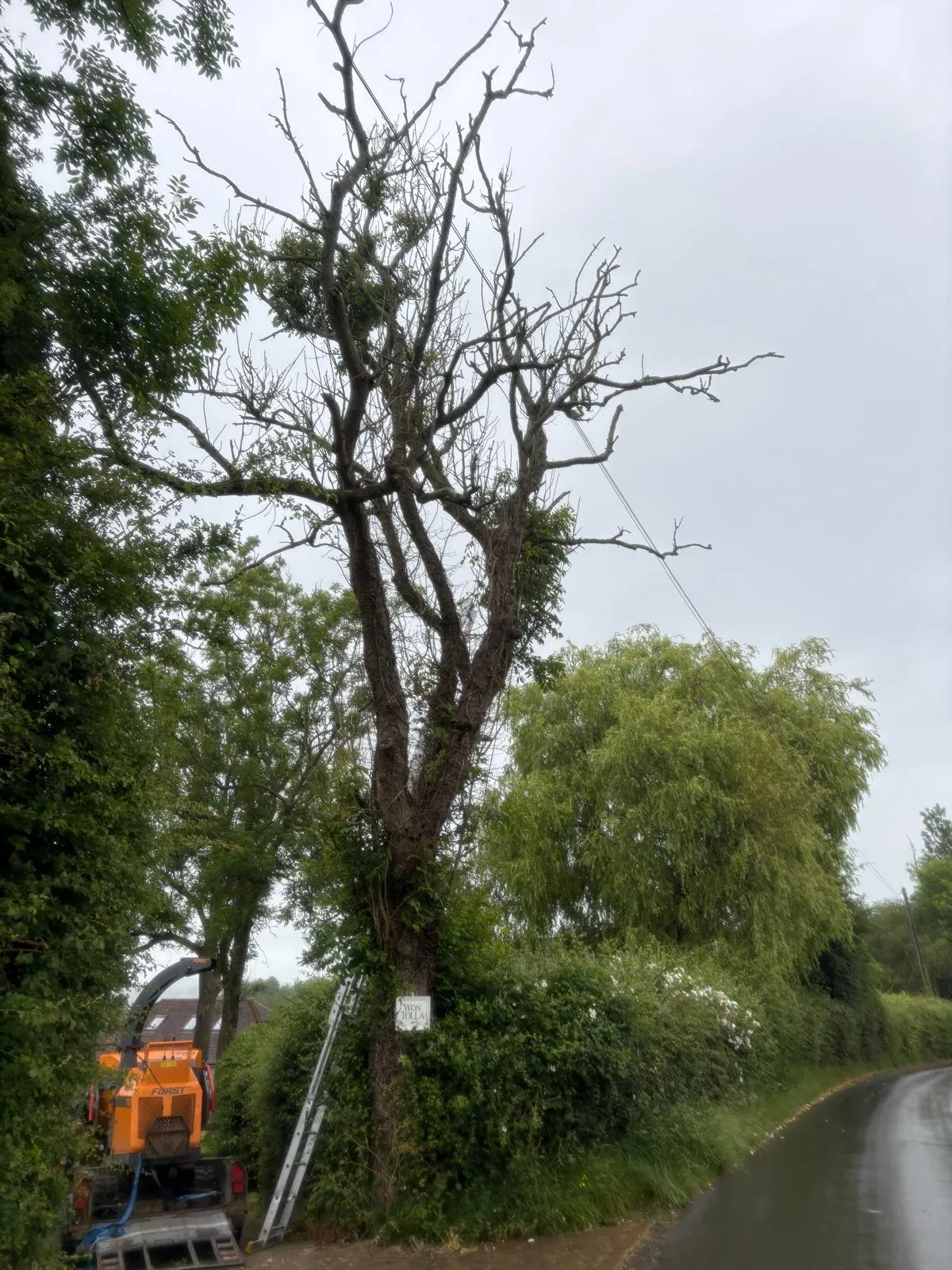
Most weeks we’re felling an Ash that’s gone over to dieback. Ash was so prominent around the South of England but its suffering massively . The hedgerow Ash you used to drive past without noticing are the ones we’re now being called out to take down before they come down on their own.
Ash dieback is the disease doing it. A fungus called Hymenoscyphus fraxineus, originally named Chalara fraxinea when it was first described in 2006. Same fungus, two names. It blew across from continental Europe, was officially detected in the UK in 2012, and is now in every English county. The Woodland Trust puts the eventual kill rate at around 80 percent of UK ash.
This guide is what we’ve learnt working East Sussex Ash dieback removals: what it is, what it looks like at each stage, why dieback Ash become dangerous fast, when to remove and when to leave it, and what the removal involves.
What ash dieback actually is
The fungus enters through the leaves in late summer. From there it works down through the leaf stalks into the twigs, then the small branches, then the main scaffold limbs and eventually the trunk. The tree tries to seal off the infected sections; the fungus moves faster than the tree’s defences. Very quickly the crown loses material from the outside in, hence the common term Ash die back.
It doesn’t kill in one season. Young ash, particularly saplings, can be dead inside two or three years. A mature ash, fifteen to twenty metres tall and a metre across at the base, can take seven to ten years to go fully. What kills it in the end usually isn’t the dieback fungus itself. It’s the secondary fungi (honey fungus is the common one) that get in through dieback wounds and rot the base.
There is no spray, no injection, no proper treatment. Researchers at Kew and elsewhere are finding tolerance in a small percentage of the UK ash population, which is the seed of long-term recovery. For the tree in your garden today, that doesn’t change anything.
What it looks like at each stage
Worth knowing before you ring anyone. The Forestry Commission and Forest Research both publish good photo guides. The visible progression goes roughly like this.
Early. Leaves wilt and turn black in summer, often at the tip of the twig first. Looks like burn or scorch. Small dark lesions on young shoots. You might spot it on saplings before you spot it on the mature tree next to them.
Established. Crown thinning. Whole branches inside the canopy stop coming into leaf in the spring while the rest of the tree leafs out normally. Bark lesions appear, often diamond-shaped, on the main stem and the larger branches. The lesions show as a darker, sunken patch where the bark is dying back.
Late. Major scaffold limbs are dead. The crown is more dead than alive. The base of the trunk shows signs of rot: bracket fungi, soft spots, sometimes a hollow you can put a hand into. By this stage the tree is structurally compromised and decisions need making.
A simple test from the ground, between June and August: look up. A healthy Ash is in full leaf with the leaves moving on the wind, even and pale green across the canopy. A dieback ash in the same week has bare twigs poking through, dead branches at the top, leaves only on the lower or inner crown, and an unhealthy patchy look. The difference is obvious when you know to look.
Why East Sussex sees it so badly
Two reasons. First, Ash was a huge component of the Weald and Marsh-edge hedgerow network. Hedge layers used it because it grew fast, coppiced well and made good firewood. There was simply more of it here per square mile than in much of the country.
Second, the climate. The fungus arrived on the east coast of England and spread fastest along the south-east corridor (Kent, Sussex, Essex, the Romney Marsh). Mild damp summers are exactly the conditions it needs to spore. The Weald and the Marsh aren’t dry country. The disease arrived early and spread fast.
The upshot for an East Sussex homeowner: if you have an Ash on your land or in your boundary hedge, the chances of it being infected are high enough to be worth checking. Mature Ash that have stood thirty or forty years are reaching a tipping point in this part of the county.
The brittle-failure problem (the bit that matters)
Most diseased trees decline gently. They lose leaves, shed branches, the wood softens slowly, the tree dies standing and stays standing until someone takes it down. Ash dieback is different.
When Ash dies, the wood goes brittle. Much more brittle than the wood of a healthy Ash, and much more suddenly than other species die. A dead-or-dying Ash limb that looks roughly like a dead-or-dying limb of any other species can shed without warning on a still day, never mind in wind. The branches that come off are big enough to kill someone, and the trunk failures we see are sudden snap-outs at half-height, not the slow lean-over of a wind-thrown Oak.
This is the safety case for getting on with it. A diseased Ash next to a road, footpath, parked car or house is a piece of falling timber on a slow timer, and nobody can tell you how long the timer is.
When you need to remove it
Get it down if any of the following are true.
- The tree overhangs a road, a public footpath, a driveway, a parked car or a building.
- The tree is within falling distance of a house, a shed, a greenhouse or a garden seating area you actually use.
- The crown is more than about a third dead and the lower scaffold limbs are losing branches.
- You can already see bark lesions on the main stem at chest height or below.
- Bracket fungi are coming out of the base or you can find soft, punky wood where the trunk meets the ground.
Any one of these on a dieback Ash is enough to act on. Two or more and the conversation is when, not whether.
When you can let it stand
You don’t have to take every diseased Ash down. Trees that pose no risk are worth leaving as habitat where possible. The Tree Council’s “Ash Dieback Disease: A Guide for Tree Owners” makes this point well: standing dead Ash is excellent habitat for woodpeckers, bats and invertebrates, and the slow collapse of a dead ash in a field returns a lot of biology back to the soil.
Sensible scenarios for letting one stand: deep in a paddock, far from any boundary, hedge, road or building. In the middle of a wood you own and rarely walk through. On a field margin where the fall direction is into open ground. The rule in each case is: would I be happy if it came down at four in the morning in a gale, with nobody asked. If yes, leave it. If no, it’s a removal.
The middle case is the awkward one. A diseased Ash on a paddock boundary, fifty metres from the house, ten metres from the lane. Ours would be to walk it with you, look at the lean, the rot at the base, the dead limbs and the fall direction, and tell you straight. That’s what the free site visit is for.
What removal involves
A dieback Ash removal is usually a dismantling job, often sectional. The on site job depends on the size of the tree, the access and the fall area.
The straightforward version: a smallish mature Ash, fifteen metres, with a clear drop zone away from the house. We fell it in one piece from the base, drop it where we want it, snedd the limbs, ring up the trunk and chip everything below firewood diameter. Logs stacked where you want them, brash chipped on site, then removed if needed, the place left tidy, we could well be in and out in one day.
The sectional version: an Ash next to a house, against a boundary, or up through a hedge with nowhere to drop the timber. We bring the MEWP in if the ground will take it, or rig it down using ropes and pulleys. Pieces come down on the rope, get cut to length on the ground, and the chipper runs through the day. A sectional mature Ash is usually a full day to get down, sometimes two if access is restricted.
TPO and conservation area considerations
A Tree Preservation Order or a conservation area boundary doesn’t stop the felling of a dieback Ash. Councils generally approve felling for ash dieback if a qualified tree surgeon assesses the tree and the application explains the safety case.
What it does mean is paperwork. A Section 211 notice if the tree’s in a conservation area (six-week wait). A formal TPO application if the tree has an order on it. Both go on your local council, with the method, the species, the reason and our credentials attached. We do the paperwork for you. If you’re not sure whether your tree is TPO’d or in a conservation area, send us the address and we’ll check the planning map before we quote.
There’s a longer piece on this on the site: TPOs and Section 211 notices, explained.
What it costs in East Sussex
In 2026, a domestic ash dieback removal typically runs:
- Smaller mature ash (10-15m), good access, clear drop zone: £600 to £900
- Mature ash (15-20m), sectional dismantle, restricted access: £1,000 to £1,800
- Large ash (20m+), MEWP-assisted, paperwork to file, brash to chip and remove: £1,500 to £2,500
Stump grinding is usually quoted separately and runs £100 to £350 per stump depending on size and access. We don’t charge for the site visit and we don’t charge for the quote. See felling for the service detail.
What replaces a felled Ash
Don’t replant ash. Replace with a species that fits the spot and the soil. Round these parts, our suggestions are usually:
- English oak (Quercus robur) where there’s space and depth, and you can wait. Five hundred years of canopy if nobody messes with it.
- Hornbeam (Carpinus betulus) for hedgerow and field-margin replacement. Native, hardy, takes coppicing well.
- Common lime (Tilia × europaea) for larger gardens that need a tall tree in a generation rather than a century.
- Field maple (Acer campestre) for hedgerow and smaller plot replacement. Native, fast.
- Wild cherry (Prunus avium) where you want flower and fruit, on the same scale as the Ash you’re replacing.
Avoid anything fussy or exotic for hedgerow and field-margin work. The Weald evolved with a short list of species and there’s no good reason to break it.
The short version, if you’re skim-reading
- Ash dieback is a fungal disease (Hymenoscyphus fraxineus, formerly Chalara fraxinea) that’s killing a large share of UK ash trees. In the UK since 2012, expected to kill around 80 percent of the population eventually.
- It’s bad in East Sussex because Ash was a dominant hedgerow species in the Weald and the Marsh edge, and the climate suits the fungus.
- Diseased Ash become brittle fast. Limbs and trunks fail suddenly under little or no load. This is the safety case for removal.
- Remove it if it’s near a road, building, footpath, parked car or garden seating area, or if the crown is more than a third dead.
- You can leave it standing if it’s deep in a paddock or wood, far from anything, and the fall direction is into open ground.
- Removal is a felling job, usually sectional. £600 to £2,500 in East Sussex depending on size and access.
- TPO and conservation paperwork doesn’t stop the work. We file it for you.
- Replant with Oak, Hornbeam, Lime, Field Maple or Wild cherry, not more Ash.
If you’ve got an ash you’re worried about, anywhere around East Sussex, send us a note with the address and a photo of the crown. We’ll tell you straight whether it needs taking down or whether it’s safe to let nature do its thing.